








REVIEW :: Dungeon, The Early Years Vol. 1
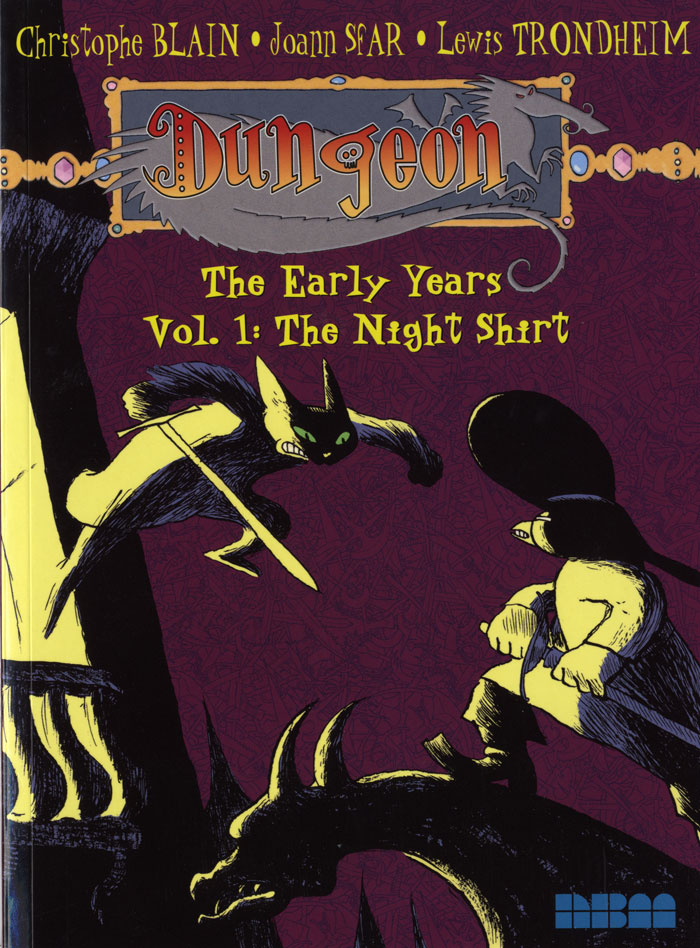 It is hard to start talking about Dungeon–it’s a strange animal for sure. A loose collection of stories centering around the titular “Dungeon,” a towering edifice visible “from 10 days march away,” and taking place in different points throughout the Dungeon’s existence.
This is the confusing part for new readers–according to its authors (Lewis Trondheim and Joann Sfar), the sprawling story of the Dungeon world spans a projected 300 albums (!!!), although Trondheim waffles on whether they’ll leave spaces for readers’ imaginations to fill in, or actually produce all 300 eventually.
I am almost ready to begin discussing Dungeon: The Early Years Volume One.
So the overarching story of Dungeon is broken down into three main parts: The Early Years, detailing the creation of the Dungeon and its keeper; Zenith, which is the Dungeon at its height, and stars Herbert the Duck and Marvin the Dragon; and Twilight, describing the decline of the Dungeon and its world. Strung between these little tenements are side stories like Dungeon: Parade and Dungeon: Monstres, which fill in little blanks and feature secondary characters.
I recently read all the existing volumes–I think around ten or so in English–over a week or so. It was less out of any real plan to do so, and more just that the books are SO DARNED GOOD that I couldn’t stop reading them. It doesn’t hurt that they’re written by Trondheim and Sfar, two of my favorite European cartoonists working today, and The Early Years is drawn by Christophe Blain, probably my FAVORITE European cartoonist.

There’s a thing that these guys do well which Dungeon is sort of an ultimate expression of–maybe “ultimate” is a little much, but maybe you’ll see my point. These guys, especially Sfar and Blain, draw with a loose, scratchy, almost sloppy style; the pages are obviously planned out, but the actual drawing itself is incredibly energetic. There’s ample evidence of pen points catching on paper, ink smears, white out; the comics are very human, very made, you know what I mean?
And there’s a sort of looseness, almost a silliness, about them that makes them light and carefree, like a story a friend of yours would tell at a party. Not everything makes sense, sometimes the story falls over its own feet a little, but everyone in the kitchen is listening and at the end they crack up. The story’s delivery is so light and airy that a) they get away with humor that would be ridiculous in anyone else’s hands; and b) the moments of real drama in the story work twice as well because as a reader you’re not prepared for them.
Not to mention the casual violence and sex–I remember selling several of these to a mother and her daughter in the store. I had thought that they were pretty safe for older kids, maybe preteens, and the mother had read them with the daughter so she was definitely fine with everything. But whoa nellie, when I read all the volumes I was a little embarassed that the little girl was reading this stuff.
Since all the characters are anthropomorphized animals, you lose track of all the killings and blood–after all, it’s just cartoons, right? But the cruel actions of the characters–some of which are the protaganists, bring you back to things. The world of Dungeon is a cruel world, a harsh world, even when it’s a funny world. And it’s a world definitely doomed to die, which seems evident almost from the beginning.
And it is not really a world for children, although these are precisely the kind of books that would be perfect to read without your parents’ knowing it when you were 11 or 12. Like Stephen King novels–I remember my mother buying me It and when I read it I was scandalized and excited (and terrified) by all the swearing and sex scenes and stuff, which of course seem pretty passe now. BUT NOTE TO LEGAL AUTHORITIES that I am not endorsing purchasing these books for children at our store or anywhere else, although I do think liberal-minded parents with precocious preteens would score some points with these. They’re like YA books with a PG-13 rating.

Okay, I will now begin talking specifically about The Early Years Volume One.
The mighty story of Dungeon begins with the story of its founder, who bears the manly name of Hyacinthe. The story begins at the end of “an era of great kingdoms, but that age has passed away.” Young Hyacinthe leaves his father’s tower to seek his fortune in the capitol Antipolis, where his rich corrupt uncle lives in. Idealistic Hyacinthe has a hard time adjusting himself to the fetid, sewage surrounded streets of the city, and finds himself adopting the accidental alter-ego of “The Night Shirt” to fight injustice, although he seems to unwittingly cause as much or more as he prevents.
The story unwinds like many of Trondheim’s stories, lazily and seemingly randomly–again, if anything, it’s like a story out of some oral tradition, but this suits the story well. For me it’s Christophe Blain’s art that makes things–his art is so scratchy, but the layouts are so clear that the story just breezes along. Blain is great at keeping a sense of PLACE in his art, you never need a scene explained to you, there is enough information in the panels to get what you need without being told everything.

I think of something Jeff Smith said in a HeroesCon panel last year, when I look at Christophe Blain comics. Jeff made the point that when he’s inking a panel, he does the faces first, because “they’re the most important part of the panel.” The expressions are the things that need to be right the most, and all the little touches and background details and all that are secondary, can get left out if necessary to make a deadline. Blain is great at this, his characters are always telling the story more through their expressions than anything else–although as I’ve said Blain’s backgrounds do a lot of lifting as well. In fact, it’s surprising how few words there are in Dungeon, considering that it’s written by TWO people–you would think if anything that there would be a profusion of words.
Then again, Lewis Trondheim and Joann Sfar are both master cartoonists, so it makes sense that they know better to tell a comics story in words when images are so much better.