Author Archive

SLICE OF LIFE :: Iron Man Movie = Awesome

April 11, 2008 By: Shelton Drum Category: Reviews, Slice of Life

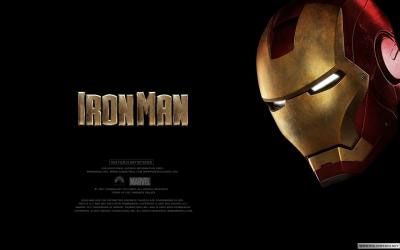
I’ve been disappointed by most of the comic book movies. For the most part they have been enjoyable, but never live up to my expectations for story content, characterization, and honor to the source material. If a producer wants to do a superhero story, why not make it as close to the comic as possible? I was blessed this week with an opportunity to see Iron Man and I can emphatically say… Finally, someone has nailed it!

Iron Man is as close to perfect as a superhero movie has been. The origin is right. It is properly paced to give it time to develop. The motivations are correct. The casting is incredible. The sets are cool as they can be. The Iron Man tech is so believable! Subplots, characterizations and motivations are all right on target. There is real drama, lots of suspense and tons of humor, just like all good Marvel comics I fell in love with. I don’t want to give anything away, but just know that the trailer doesn’t do it justice. There is cool stuff going on all the way through. Anybody off the street (I call them “civilians”) will enjoy this movie, but there are plenty of comic book references and homage to satisfy all of us “vets.”

I can’t say enough good things about this movie. Everyone, please go see it Friday, May 2nd and we can all discuss how cool is at Free Comic Book Day (shameless plug for our annual party extraordinaire) on Saturday May 3rd. I’m so excited!

Share

TOP TEN :: Best Ever Comics Artists :: #2 :: Steve Ditko

September 21, 2007 By: Shelton Drum Category: DISCUSS

Most people who know me know that I’m a big Spidey fan. And while I’m also a big fan of Stan Lee, John Romita, and Jack Kirby, there’s only one man that could have made Spider-Man work if you ask me: Steve Ditko. Spider-Man stood out right away in the Marvel universe, because he was so different than all the other characters–he was this nerdy teenager who dressed up in a weird spider costume and fought crime, meanwhile juggling school, girls, and all the other pressures teenagers face. I love Jack Kirby–some stories suggest that Jack Kirby had a lot to do with the initial idea of a “spider man”–but can you imagine Kirby doing a book like that? Steve Ditko brought the kind of energy and imagination to Spider-Man that only he could, not only in the look of Spider-Man, but often in the plotting of the book, and many people say, most of the creation of the character. Only Steve Ditko could make something as crazy sounding as “a teenage crimefighter with the proportionate strength of a spider” not only work, but become an overnight sensation. Steve Ditko only did 38 issues of what many consider the greatest comic ever, but he’s still hailed as one of the greatest comics artists of all time to this very day.
Share

Mike Wieringo :: 1963-2007

August 13, 2007 By: Shelton Drum Category: Comics Industry, Heroes Aren't Hard To Find, HeroesCon, HeroesCon News

The Heroes family is in mourning today: Sunday, August 12, fan favorite artist and HeroesCon regular Mike Wieringo suffered a heart attack and passed away. Mike was the artist behind many popular runs on big-name characters like Spider-Man, the Fantastic Four, Flash, and many more. He was also the co-creator, along with writer and close friend Todd Dezago, of Tellos. He was just 44 years old.
The unbelievable news of Mike’s death overnight was the first thing I heard this morning—it’s still impossible to accept. He was a fan at the 1985 Heroes Convention, his first one, and I had the opportunity to meet him that year. He was of course an aspiring young artist, and I thought he showed a lot of promise. He never missed another con after that first trip. I watched him work on his art from year to year, and was so proud of him when he got those first independent jobs; then practically overnight he was a pro. His art took on a life of its own, and besides his artistic talents, he became one of the most universally respected and loved creators in the industry. And at the same time, Mike was becoming a part of our/my family. He was like a brother or a son to me, and established himself as firmly with my staff and the fans. He would have done anything for me—and many times, did–and I would have for him. That’s one of the things that being a family means, doing things for one another out of love.
In many ways, Mike embodies everything that I love about comics; in a very real way, he represents our closest friends and “family” members. When we refer to the HeroesCon “family”, it’s Mike Wieringo that we’re talking about. When we say that we’re excited to see everybody this summer, it’s Mike Wieringo that we can’t wait to see. And when we talk about how much we love and cherish the many pro’s and fans that make what we do possible, it’s Mike Wieringo that we’re loving and cherishing.
And next year, when we come together again and remember the friends we’ve lost, it’ll be Mike Wieringo that we’re missing. I am proud to have known Mike for the past 22 years and to have c­alled him friend and brother. Thanks for the wonderful art, support and memories, and most of all, for your friendship. Rest in peace, Mike.
Share

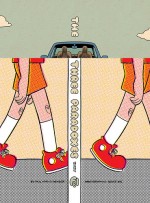
REVIEW :: The Three Paradoxes

July 25, 2007 By: Shelton Drum Category: Reviews

by Paul Hornschemeier
80 pgs :: HC :: Fantagraphics Books

reviewed by Shawn Reynolds

One of my favorite purchases during this year’s Heroes Convention was Paul Hornschemeier’s The Three Paradoxes. And after discussing it at the “Up Close and Personal” panel with Hornschemeier, moderated by the ever lovely Andy Mansell, I was very excited to get a chance to sit down and read it.

On the surface this book is simple. There are four main stories, each with a corresponding art style. The first is the story of Hornschemeier and his father talking as they walk down the street. The next story you are introduced to a young Hornschemeier searching for a bully with his friends. The third story is the origin of the man with the scar on his neck. Finally, the fourth story is of the philosopher Zeno explaining his three paradoxes. When you first begin to read this book it is hard to figure out how all the stories relate to each other. But by the time you finish you start to see how they connect. I will warn you: you will need to read this through at least two times, maybe more. It is a quick read, but it is not a light read. It is rich and dense and there are many layers and meanings.

To understand the book it is important to understand Zeno’s paradoxes. An oversimplified version of Zeno’s paradoxes is as follows: 1) you can never begin, 2) you can never catch up and 3) you can never move. For me this book is simultaneously supporting and refuting Zeno’s claims. Socrates is the voice of reason, stating that change does exist. While Socrates points out the flaws in Zeno’s paradoxes and logic does lead us to conclude that they are false, the rest of the book supports the paradoxes. That said, the book supports them in a limited way. For example, when Hornschemeier encounters the bully in that moment he could not move to defend himself. Later on he could move, but in that moment the paradox holds true (Hornschemeier directly states this in reference to not being able to move when he sees the scar, but I wanted to point out a less obvious example). Change seems to be inevitable and yet when you want something to change it seems like it never will.

An interesting aspect of this book is the symbolism of the road. It is a symbol for change and progress. Roads take you places. They send you out on journeys and they bring you back home. When you walk across the street you can become a different person. Also, it is a symbol for danger. Bad things can happen on the road. And bad things can happen when you travel down the road. In my 11th grade English class the teacher discussed the importance of the river in The Adventures of Huckleberry Finn. She said that it symbolized a baptism. Every time Huck got into the river he changed. In The Three Paradoxes the road takes on the same significance. Just how most of the action takes place in or around the river in Huck, most of the action takes place in or near the road in Paradoxes.

Enough about philosophy and symbolism, let’s talk about the art. There are five different art styles which help  to differentiate between the stories. This distinction is important, if there wasn’t a sharp contrast between stories the book wouldn’t flow and it would get really confusing really quickly. The story of Hornschemeier and the bully is told in a child-like comic strip style; whereas, the story of the scar is like a comic book from the 1970s (complete with yellowed paper). What strikes me most about the different art styles is that the Zeno story seems to distinguish itself from the other stories. It appears to be a separate entity, not a part of the larger narrative. The other stories relate directly to Hornschemeier, either his past or his thoughts. But this story isn’t about Hornschemeier. It is about some philosopher a long time ago. The Zeno story may be separate, but it is integral to the understanding of the story.

I think this work is highly successful. The art, the dialogue and the flow of the stories all work together to make this a rich and complex work. If after reading this Socrates is not your favorite philosopher then something is wrong with you!


Share

Review :: Showcase Presents: Batgirl Vol 1 TP

July 13, 2007 By: Shelton Drum Category: Reviews


written and/or illustrated by creators including John Broome, Neal Adams, Dick Giordano, Carmine Infantino, Gil Kane, Frank Robbins, and more

reviewed by “Sassy” Shawn Reynolds

After seeing the cover to this volume I knew I had to read it. It has Batgirl taking time out from a serious battle to re-apply her make up. Isn’t that just like a woman?

With almost 30 Showcase Presents trades in print this is the first one devoted to a female character (Marvel’s not doing much better. With almost 100 Essential trades in print there are 3 that star a female character). It reprints DC comics from 1967 to 1975 and features artists and writers such as Carmine Infantino, Neal Adams, Gil Kane, Frank Robbins, Dick Giordano and many more.

For those of you who are not familiar with Batgirl, she is Barbara (Babs) Gordon, Commissioner Gordon’s daughter. Babs is Head Librarian of the Gotham City Library by day and crime fighting vigilante by night. This PhD wielding bibliophile also has a brown belt in judo. Underneath that mousy exterior is a superhero waiting to be unleashed.

These old issues are hilarious. My feminist sensibilities should be offended but the stories are so much fun to read that I can’t help but enjoy myself. Babs is portrayed as vain and shallow and even though she is very educated she isn’t as smart as any of the male characters. Being a library assistant I also should be offended by the way librarians are represented. But again it is so comical that I can’t help but like Babs as the “plain jane” librarian. Let’s face it: that stereotype is obviously false. If you don’t believe me, check out the New York Times from Sunday July 8. There is a whole article about how librarians are hip.

I get the same kind of enjoyment out of reading these old issues as I do from watching old beach movies like “Beach Blanket Bingo.” The movies are funny, light-hearted and campy but they also cause me to step back and look at how the perception of females in the media has changed over the past 30 or 40 years. We can all laugh at it now because we know that women are more than pretty little things who are obsessed with finding a husband.

The only drawback for me is that these reprints are in black and white. But the stories are so enjoyable that I didn’t mind. And without the color you really get a sense of the line work. These guys are amazing artists.

This is great summer reading and what I call “delightfully sexist.” Plus it is over 500 pages. That is a lot of bang for your buck.

Share


  • heroes on facebook heroes on twitter heroes on flicker


    Click Here To Help Support The Creators That Make Comics Possible!


  • www.flickr.com