









THE BETA CANON :: Gus And His Gang, Vol 1

While we all would think of books like Maus, Dark Knight Returns, or Watchmen as comics “canon,” there are a growing number of books that I am coming to think of as, if not canonical in and of themselves, then at least “must-read” books. Maybe they’re still too new, or their influence has not grown enough to be considered part of a comics canon–but in an age with more high-quality literary comics than ever, it follows that the canon will eventually grow and adjust to this new influx. So, for now: The Beta Canon, or at least my version of it.
(NOTE: I’m having a hard time getting WordPress to let me post these images below in a way so when you click on them, they expand to a readable size, BUT if you right-click and choose “Open In New Window” or something like that, that should work.)
Gus And His Gang, by Christophe Blain, came out in 2008 here in America, although I think it was published first in France in 2006 or 2007, and possibly (probably?) in a different form. When the book came out I was already a fan of Blain’s work, having read his two volumes of Isaac the Pirate and his (even-better) graphic album The Speed Abater. I say “liked,” which is correct–they are enjoyable books, good but not really earth-shattering. So when Gus came out, with its garish safety-orange cover, and its Wild-West subject matter, I looked forward to reading it but wasn’t really peeing myself or anything. This seems to be the opposite of a lot of people more connected to European comics than I am–some people were let down by it after all the hype it received, and a lot of people didn’t notice it at all.
But when I grabbed it one day on the way out the door for lunch, needing something quick to read… well, by the end of the first story I was in love with it, and by the end it had become one of my favorite comics EVER.
It’s hard to pin down exactly why, which is the strength of Gus, and maybe its weakness for others. Some books just resonate with some readers; there’s something ineffable there that hits just the right combination of notes to form that perfect chord. You know what I mean? Like you can feel it happen and then hear that vibration for the rest of the reading experience. Most of my favorite books do this, and Gus for sure caught me off guard.

Moreso than Blain’s other books, Gus And His Gang employs a really gestural, expressive art style–similar to the kind of high-energy, fast style of fellow Frenchmen Joann Sfar and Manu Larcenet. What looks at first to be rushed or even sloppy, reveals itself to be well-planned, well-executed storytelling, without a lot of the fussiness that often gets in the way with lesser storytellers. You can almost FEEL the artist making his brush strokes and pen lines on the paper, you imagine him bent across his drawing board, making decisions, deciding when a panel is done, how much nuance is enough…

It’s organic, I guess. It’s like the book has just grown right up in your hands, that if you were to mash your nose into it you’d smell the rich loamy earth of France itself. It’s constructed in the same way–the overall story (so far) seems less like a linear a-to-b progression, and more like an aggregation of story, like a herd of cattle stretched across some plain. Ditto for the way the action can skip from action to humor to death to sex, at once silly and and serious enough to keep you worrying about the characters from moment to moment.

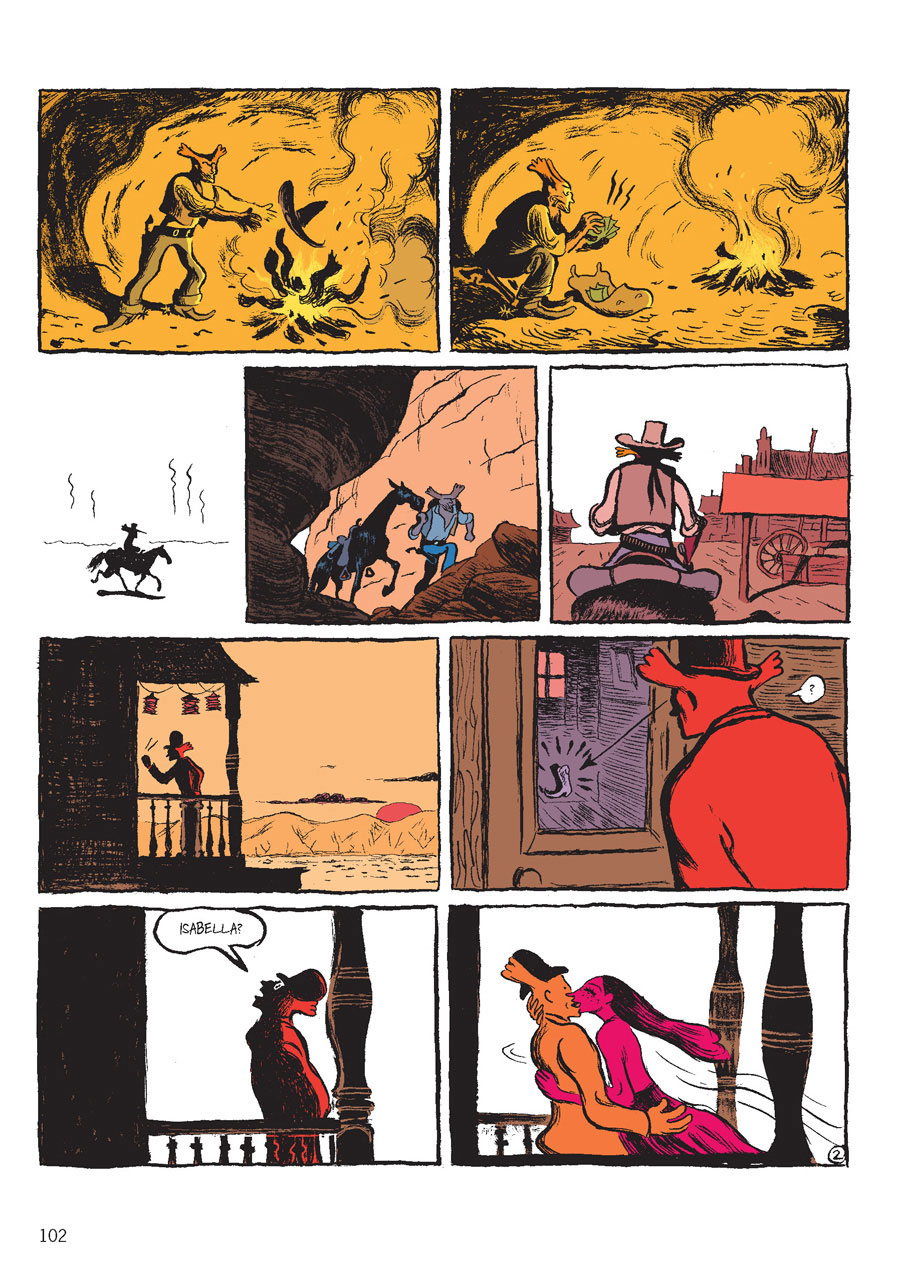
In fact, while the titular star of the book is Gus himself, most of my favorite stories center around the more taciturn Clem, he of the red broccoli hair. Where Gus will say and do anything to achieve his ends, be they love or money, Clem is more complex, has some scruples (though often violated scruples, even so). Clem is no less a philanderer than Gus, but Clem is haunted by his own guilt, in the form of a towering one-eyed version of himself that haunts his spiciest moments. Through Clem we meet Isabella, whose appearances are SO spicy, I had a hard time finding a page I could even show on our blog that wouldn’t set off alarm bells.
Which makes writing about it even more challenging–Blain uses the cartooning form brilliantly to show the various moods and inner thoughts of the characters, not only through body language but the use of what cartoonist Mort Walker called “emanata”–the various stars, sweat beads, squiggly lines of frustration, and other abstract marks that tell the reader what’s going on without using boring old words.

It’s the CONFIDENCE of Blain: his drawings seem effortlessly made, almost gestural. Instead of fussing with getting this line or that just so, he concentrates on the subtleties of posture and the “acting” his figures are doing on the page. In the page above, Blain takes a simple moment and stretches it into 8 mostly-silent panels. Look at all the information you get there: though there’s no establishing shot or other reference to location on the preceding page, it’s easy to imagine where Clem and Isabella are. Even more impressively, Blain indicates the blocking of the scene itself without hardly moving his “camera” at all.
Isabella comes in, moving to the right (the way the eye is moving as well, left to right, as it reads), then looks back (against the “flow” of the reading) towards Clem. This has the double effect of telling us where the two are in relation to each other, again without any single shot containing both of them; AND it increases the importance of her look because the speed of our reading is interrupted by the reversal of the regular left-to-right flow by her look back.
From there it’s perfect: beat, beat, then boom! Clems’s eyes open up and he’s in love. Isabella continues moving with the flow of the eye and our special moment is ended. I love it!
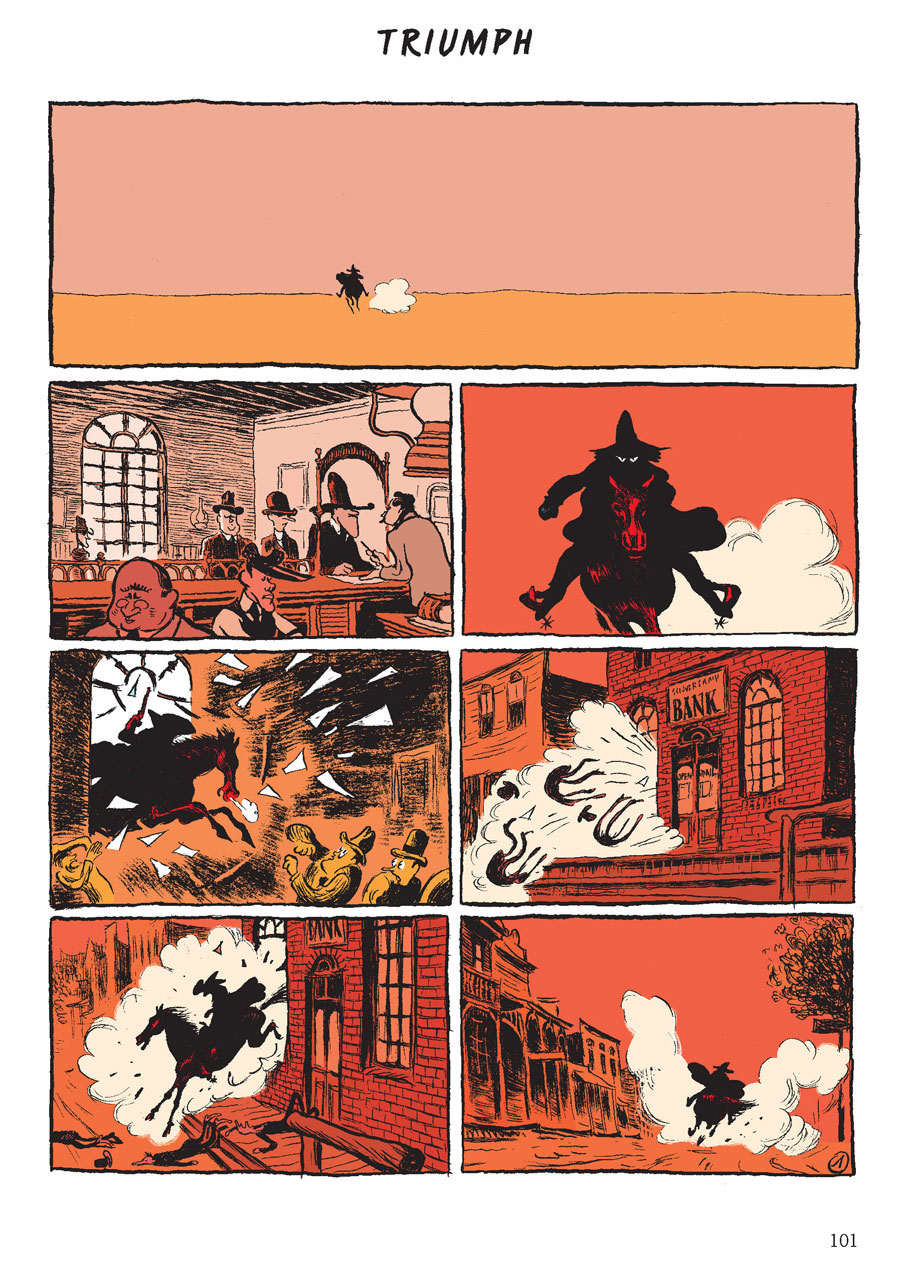
But I think maybe my favorite thing about Gus & His Gang, or at least the thing I find myself thinking about the most, is the colors. The palette the colorist uses is just crazy, all these bright colors from all over the spectrum. He goes from super bright, almost magenta shades to electric blues, but it’s never noisy, everything always makes sense. And the pages are so BRIGHT. He’s also not afraid to just leave a background totally white–the pages seem to breathe, everything seems so airy. It might even undermine the overall sense of danger that most “Wild West” stories have, but I guess I don’t mind much. I’ve definitely tried as hard as I can to appropriate this palette for myself in my own humble efforts, but so far without the grace and panache of the colorist, whose identity was kind of hard to figure out for awhile. But Gina Gagliano over at First Second informs me it is “Clémence”, and worked closely with Blain himself on the palette. Thanks to Gina and especially Colleen AF Venable for helping me get all these images together real easy. The best!
I’m not sure if this is the first volume of a continuing series or not. Jeez, I sure hope so; I love it so much. It is hard to imagine a book that’s come out over the last couple of years (a time RIFE with incredibly good comics) that has influenced me more that this one. Although I will try in the coming months, as I write further on my choices for this “Beta Canon.”
Have you read Gus or any of Blain’s works? I’d love to hear what you think in the comments section. Let’s hear it!










I too love this book. I had been waiting for more English translated Blaine works and I was not disappointed. You need to order Speed Abater and Isaac the Pirate series from NBM. They are even better then Gus in my opinion. His beauty of line is mesmerizing to me. He knows how to move your eye across the page. Something many sequential artists have a hard time doing. This is what “indy” comics can achieve when a master is creating. Now if someone can just translate more of his works I would be ever so happy.
Peace,
Herc
Oh Herc, we’ve got both volumes of Isaac AND The Speed Abater at the store now! I agree that Speed Abater is good, but I like this a little better, I think.
haha I haven’t looked around the store in a while. I figured you guys would have ordered them. I like the comedy in Gus a good bit. I’m glad you dug the book too. I’ve been trying to tell people about it since it came out. BTW: Well written piece, brother.
peace,
Herc
Great write-up Dustin. This is also one of my all-time favorite books of the last few years–and the coloring in particular, as you point out, is spectacular. In preparation for some coloring work of my own, I recently did a blog post myself outlining what elements of the coloring in GUS really make it tick. You may want to check it out here. It’s worth noting that the mater of exactly who colored GUS is not entirely settled at this point….
Hm are you sure? I only say this because I pointedly asked Gina at First Second and she said it was “Clémence”. Perhaps the mystery is tied up with that little accent over the e, no?
Yeah, as mentioned in my post, I also contacted Gina, who said it was Clemence. On the other hand, the French editions of volumes one and two are apparently credited to Walter–who is mentioned by Bart Beaty (who reads French) as the colorist in that Comics Reporter thing you mention above. Click through some of the links on my post on my blog and you’ll see the credits all from a French BD site listing Walter as the colorist.
(P.S. – Can I suggest the addition of the “subscribe to comments” wordpress addon?)
Excellent suggestion! I will begin looking into this next week.
ALAS, one of the great comic books of our time absolutely ruined by crappy sub-par UNREADABLE lettering.
Still, the cartooning is so good, you want to forgive the slight, but the extra effort– the squinting etc– detracted from the overall experience.
I see Blaine’s influence in Harbin’s work; he is a master and I believe this book has helped you raise your game to a higher level.
BUT, the difficulty I had reminded me of the old–pre Digital age–when you had to watch black and white foreign films with white subtitles that were so hard to read it you just wanted to give up.
Am I just being argumentative?? I say, no. This kind of production slight is unacceptable–especially for a potential classic.
In the eighties, when NBM published the Captain Easy Sunday pages split in two separate pages to fit their volume, I had the exact same reaction. One of the great comics of all time, but presented in such a way that it performed a disservice to both the work and to the reader.
Last example– but it is a good one: Reading this version of Gus was like trying to watch Tati’s Playtime or Lean’s Lawrence of Arabia on a small screen in pan &scan (as opposed to letterbox). The presentation harmed the work irrevocably.
Thanks for listening.
I didn’t have a problem at all with the lettering; in fact, I’d really not considered it until I read your post, Andy. I wonder, though, if trim size is partly to blame. Most of the European volumes of stuff I own and have seen in shops in Europe are the size of those big TinTin books (maybe 12 x 9 or something like that). I wonder if the US editions of this stuff, both from First Second and from NBM are printed substantially smaller than they were intended to be read at?
I don’t mind the lettering so much in THIS volume, although I am often mortified by the awful computer fonts that designers (or the artists?) choose for some of these translated books. I see the lettering size as a different, less aesthetic issue–one I’m less sensitive to just because I write super-small. Shelton and I often have this issue when I’m working on design stuff, as he often points out that past a certain point size, everything is illegible to him.
Nice review, Dustin! I enjoyed Gus a lot. I like short stories centered around a single character–esp when there’s humor. But I decline to put his books in a heirarchy–SPEED ABATER is it’s own thing. So is ISAAC THE PIRATE. This does feel like an artist finding his own voice, though; so to that extent I’ll “rank” it higher.
I agree with those who would rather see comics DRAWN for album size PRINTED at album size. But I’m getting old and my vision is less flexible than it used to be, you young whipper snapper!
I think I like Speed Abater because it is one thing, a nice compact little statement. I was actually kind of let down by Isaac, mainly because it hadn’t gone that far in two volumes, and then…. I mean, are more every going to come out? I think it was like 5 years ago when #2 came out.
One of my favorite things about Gus is the breezy way the story is told, much more so than Isaac. The way elements pop up and disappear gives a lot more room for that world to breathe, and since we follow numerous different characters there’s an idea of the world being much larger than what we’re seeing.
Silly me–Andy, there is already a Comments RSS feed in the right sidebar, down there with the login and other meta stuff. Also one for entries. Both are repeated in the footer!
[…] August I posted this long look at Christophe Blain’s Gus & His Gang, a book I return to often in my thoughts, over on […]