above from “Basewood” by Alec Longstreth, serialized in Phase 7 Comics.
Longtime Heroes Aren’t Hard To Find customer D. Blake Werts recently sent me an e-mail, in which he asked:
“What is the indie world? What makes it ‘better’ than mainstream? Where would one start? Who is it for?”
To put Blake in context a little, he’s been a customer since way back at the “old” location, where he would buy and play Magic and dabble a little in comics. Blake’s one of those customers who come in once in a while to check stuff out; he’ll usually catch up on a few of his favorite series, maybe try a few new ones. He’s a good representative for the kind of customer we’ve seen in the store more over the last 5 years or so, who’ve come to comics through other avenues, who didn’t necessarily grow up on them but recognize them as a potential source for entertainment, for art, for whatever.
Blake sent me a follow-up email to explain a little bit–he knows I’m into predominantly “indie” stuff, as far as my reading of comics goes, and was wondering what the allure and/or difference was. Sometimes we forget that the world of comics is still a somewhat small one, and so what we take as accepted wisdom may be inscrutable to someone new to comics. Or vice versa–notice how comics people’s eyes roll when someone refers to the new Sonic collection as a “graphic novel” or calls Japanese comics “anime.” Like any subculture, we can all be a little snobbish without realizing it, I think.
So I told Blake I’d try to address his question and explain my “indie” thinking, here on the good ol’ blog:
First of all, “indie” is just a broad term, and a pretty flawed one at that. I think we (or, at least, I) use the term “indie” in the same way we referred to “alternative” music in high school in the early 90’s. Back then bands like U2 and R.E.M. were “alternative,” ostensibly an alternative to some perceived mainstream sensibility. Which seems silly now–I mean, can you get more mainstream than U2 or R.E.M. today? It’s hard to think of any band who sells out massive arenas as anything but mainstream.
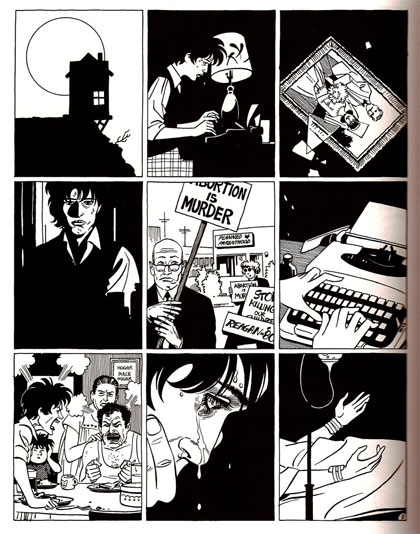
above, from the story “Flies On The Ceiling,” by Jaime Hernandez, reprinted in “Love & Rockets: The Girl From H.O.P.P.E.R.S.“
Ditto for indie comics. To vastly oversimplify, the indie comics world started up more or less with the underground cartoonists like R. Crumb and Gilbert Shelton, who were just making weird counterculture comics that would get sold in head shops and at concerts. With the 80’s came the “black and white boom,” when titles like Love And Rockets, Yummy Fur, Teenage Mutant Ninja Turtles, and Cerebus were getting big.
Note the lack of a unifying thread between those titles–Cerebus started as a Conan parody, TMNT was a pretty violent book about.. well, you know what it’s about, Yummy Fur was a collection of absurdist and autobio short stories (sometimes both), and Love and Rockets was by THREE different brothers, all telling different stories in different genres. But while TMNT and Cerebus were more or less self-published, L&R and Yummy Fur had publishers, if not massive ones: Fantagraphics and Vortex, respectively.
Vortex is no more, but today Fantagraphics publishes some pretty high-end books, including recent strip reprint collections like Popeye, Prince Valiant, and Peanuts; the last of which has been so successful as to essentially bankroll many of the company’s other ventures. Can we say that the people who publish Peanuts are “indie”? It’s a flawed question, but maybe you see my point. Or newer publishers like Dark Horse, or more recently IDW, who began as small companies but now make much of their profit from licensed properties like Aliens, Star Wars, Transformers, and GI Joe?
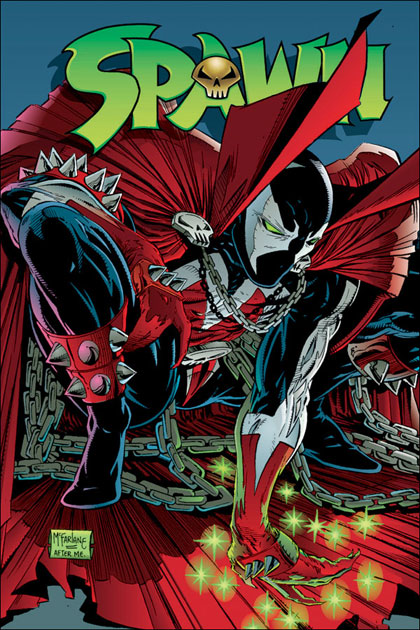
above, cover to Spawn #8 by Todd McFarlane
Or is “indie” just an alternative to “superhero”? Certainly the lion’s share of comics published today, even in these times of wildly increased diversity in comics, are superhero books published by Marvel and DC. So does “indie” just mean “not superhero”? That seems broad, doesn’t it? If I made a comic and published it myself tomorrow, a comic about a snaggletoothed comics shop employee who donned a cape at night and fought crime, and called it “Dustman,” would that be a mainstream comic just because it had a superhero in it? Also, publishers: let’s do it, Dustman has serious movie potential.
So: first of all, indie is not a great term, but who knows if there’s a better one? Comics has never been a great place for nomenclature–“graphic novels” are usually just long comics, not “novels” at all, at least in terms of narrative scope and complexity. Ditto for the term “comics” itself, which has been out of step since 1945 or so. “Comic Books” are rarely that funny, at least not on purpose.
Secondly: indie comics are certainly not better. There are indie comics that are amazing and indie comics that are awful, and the same holds true for mainstream comics. For every Maus or Batman Year One, there’s some terrible handmade comic about sociopaths or something; for every amazing handmade comic like Snake Oil or superhero story like Watchmen there’s a… well, I don’t want to call names. But you know what I mean. Making a qualitative decision on something based on its estimated popularity is just dumb and a waste of time.
A better qualifier, if you’re bound and determined to generalize something, is genre. For instance, I haven’t read Walking Dead before, mainly because I’m not much for horror, never have been. YES, I know it’s probably one of the best-written comics coming out these days, I GET IT–but that genre doesn’t do a lot for me, I don’t like being scared. Walking Dead is published by Image, which is (I think?) still the third biggest comics publisher in the U.S. market, so it’s hard to call it indie–on the other hand, it’s a creator-owned book published in black and white about zombies. On the other hand, it sells better than crack. What’s my point? I’m not sure. Let’s move on.
Thirdly: Let me suggest that the term “indie” may refer to a certain narrowing of focus, a book made with very specific ideas in mind, often for a very specific market. Think of it like this–DC can only get so adventurous with Superman, right? He’s an American icon, he’s the flagship character of their entire company, he’s tied to all sorts of licensing, whether it be in animation or merchandise or (one day) movies again… As such, DC has to make Superman, and really most of their “big” characters, appeal to the widest possible audience. Because essentially Superman exists to make money for someone. This isn’t a bad thing–after all, this is why Superman was created in the first place, originally to make some money for Siegel and Schuster, but not so much as it turned out.
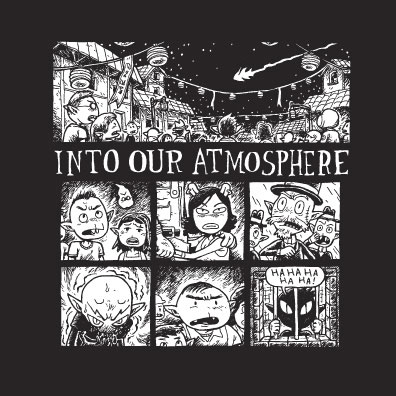
above, from intro to The Mourning Star, by Kazimir Strzepek
Indie comics also exist to make money, but usually as a secondary pursuit, or at least to a more targeted niche market. The Mourning Star (one of my faves) is a sci-fi/adventure book by genre, but that doesn’t mean it’s going to sell to everyone who likes Star Wars. Even big “indie” sellers like Sandman are created with more literary-minded readers in mind–while it’s possible that the same person buying Spawn may also read Sandman, it’s not necessarily the likeliest two books to be brought up to the counter together.
Maybe “indie” just means “more personal?” Or “niche market?” The thing I really first think of when I think of indie comics is MINI comics, another problematic name that really means “handmade” comics. Although even those are not always handmade. But usually somebody is writing, drawing, printing, folding, and stapling the thing themselves, sending them to shops or selling them at conventions. The interaction between creator and audience is immediate, there is no middleman, no publisher, no distributor, often not even a retailer! In this sense these particular indie comics are not only more personal in their content, but in their creation and delivery. Which maybe is a good original descriptor for what makes something “indie,” but in today’s massive marketplace, that line is so blurry as to be little more than a semantic argument anymore.
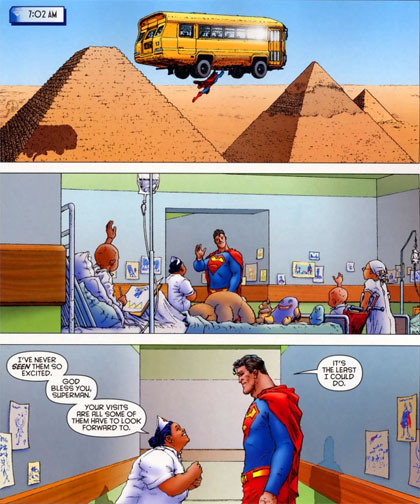
above, from All Star Superman, by Grant Morrison & Frank Quitely
What it comes down to is quality. Superhero comics can be AMAZING, I think All Star Superman is one of the best comics of the last decade, and Batman Year One is my favorite comic EVER. They can also be terrible. Indie comics can be incredible, you’re often getting a story or a message undiluted by an editor or the rigorous natural selection of marketplace economics. And that can be a bad thing too–I would hazard that MOST artistic ventures could be improved with some well-placed edits..
So, to answer the last of Blake’s questions: where to begin with indie comics is: wherever you like. Talk to people, ask the employees at your favorite shop. If you shop at Heroes, you know we are bottomless wells of comics conversation, and are happy to carry you around on our shoulders if necessary to show you books we like. A question I like to ask new customers, or customers just looking to try something new, is “what’s the last good book you read?” which if nothing else provides a starting point. The comics shop is just like any book shop, except our books have LOTS more pictures. There is something on those shelves for every level and flavor of reader, and browsing those racks is one of the more pleasant ways to find new stuff. Whether you’re a superhero reader looking for some indie stuff, or an indie reader who’s looking for something a little less SERIOUS (jeez lighten up you indie guys!), there is plenty out there for you.
But what do YOU think–is there that big a difference between “indie” and “mainstream” comics? Or is the difference just one of audience? Of market? Or of content? I’d like to hear what you think, O Gentle Reader!