Archive for the ‘DISCUSS’

REVIEW :: Two Takes On Sci-Fi Superheroics

May 05, 2009 By: Carlton Hargro Category: DISCUSS, Reviews

I recently read two rather entertaining science-fiction-flavored comics from Marvel — with two very different approaches to the genre.

First up was Astonishing X-Men No. 29. I know that the X-Men is widely thought of as a superhero comic. But as Grant Morrison proved during his acclaimed run on New X-Men a few years ago, the X-Men is best when it’s considered a sci-fi book. Writer Warren Ellis delves even deeper into the sci-fi pool by telling a tale of artificially created mutants and instant parallel universes. Ellis’ approach is incredibly cerebral — short on action but long on big ideas. For some, this may come off as a “talking heads” issue — and it is thick at times — but the arc’s ongoing mystery presents some challenging concepts. And its ending leaves us with an ominous cliffhanger.

Now, where Astonishing X-Men was all about heady ideas and challenging exposition, Guardians of the Galaxy #13 is all about mindless action and fun. This month, the team gathers all its old members, officially adds a few new heroes to the team and gets involved even deeper in the “War of Kings” crossover event. I’ve been promoting this comic for months; for me, it provides the best old-school Marvel fix of any comic on the stands. It’s got guest stars galore, the most far-out pseudo-science ever and features probably the lamest cast of any team in comics — but that’s the draw. Guardians has become, for all intents and purposes, the repository for all of Marvel’s “homeless” cosmic characters. So if you like Bug from the Micronauts, Moondragon or Rocket Racoon, buy this book.

Share

REVIEW :: Whatever Happened To The Caped Crusader?

April 27, 2009 By: Andy Mansell Category: DISCUSS, Reviews

written by Neil Gaiman and illustrated by Adam Kubert and Scott Williams

I am going to make the assumption that virtually all of you have read these two issues. This is the kind of book everyone buys even if they do not regularly read Batman. Just in case: I need to post the words SPOILER ALERT, because this review has to examine the ending of the story.

My initial reaction to the story was one of complete disappointment. From what I’ve been reading in blogs and hearing from customers in the store, the general consensus seems to agree with my initial assessment.

It is impossible to read this story without comparing it to the final Mort Weisinger/Julius Schwartz era Superman tale, “Whatever Happened to Man of Tomorrow?” The Alan Moore story was an instant classic. It was the end of an antiquated era that sorely needed to be put to rest. Because of it, the story was able to evoke deep emotions in the reader as it it treated its subject matter as if it was the death of a very dear old friend.

Therefore this two-part Batman story–with its title, timing and the use of the literate British superstar writer –begs for comparison to the well established Superman classic. It would be impossible for any story to come close to Alan Moore’s triumph from 20-odd years ago. Thus my initial reaction to the story was a complete let down.

I felt the two issues led me too far in too many directions and culminated in an unsatisfactory finale. It left me feeling cold and almost angry. But I had this nagging feeling that I must be missing something. I am not a blind faith fan of Neil Gaiman; but I cannot deny that he is a very clever writer and he has a huge reputation to uphold. So even though I was disappointed upon my initial reading, I had to assume that there is more to the story than originally met my eye.

And sure enough; a second reading proved to be quite rich and satisfying. The plot is simple: Bruce Wayne/Batman is watching his own wake with a mystery woman whom we were all either hoping or dreading will be revealed as Death from Gaiman’s Sandman. We learn in the second issue, it is Bruce Wayne’s mother who has been assigned the role of his spiritual guide.
The story ends with Bruce Wayne coming to the understanding that he is Batman, he is destined to be Batman and the only way Batman’s story can ever end is with his death. But…. the story can never end.

Regardless of how many times you re-invent the character, one thing will always remain: Batman is at heart a boy’s revenge fantasy. He must always succeed because he is stronger and smarter than every other human. He can overcome any adversity and win the day for the greater good–just like a hero should.

Gaiman uses the wake to delightful and rather inspiring ends. Admit it, any of the one and two page stories of Batman’s demise would have made an incredibly fitting coda to Bruce Wayne’s four color life–Batgirl and the Bomb, Harvey Bullock and the kid, the final physical and mental victory over the Joker. There are several more within the story’s framework and each one comes close to affecting the reader in the same satisfying manner as the special moments within Moore’s final Superman tale.

The two stories that get the majority of page-time show that Batman could never settle down and receive that well deserved happy ending. Catwoman’s tale shows us the Batman’s life is tragic and cannot withstand a romantic relationship. This is a very moving, chilling and perverse tale of obsession. It is a terrific tale and climaxes in a surprising way.

Even better is the story of Alfred and the role(s) he plays in Batman’s life. This is a very clever tale that shows above all that Batman’s story will continue to be twisted and manipulated away from the original boy’s revenge fantasy concept into something else, either silly and antiquated—like the Caped Crusader from the 40’s to the 60s—or something violent and “realistic”, like the Dark Knight of the 70s to the present. Batman will be nothing but a pawn of the actors and writers who pull his strings and the audience who determines the extent of his popularity.

The story’s wrap-up is a bit of a challenge. The shape of the Bat signal morphing into the hands of a new born is absolutely inspired and the final image of a new mother’s joy upon looking at her infant son successfully masks –for the briefest moment –the true “reality” of the Batman character. But Gaiman makes it clear that this is not going have a happy ending. Batman will not retire to suburbia like Superman. Martha Wayne’s joy cannot equal Superman’s wink; hence the original feeling of anger and disappointment.

But Gaiman is reaching for something more, something richer, something darker and something that is NOT happy. Batman is the absolute dark reflection of the Christ figure. Instead of dying for our sins—which the previous 40 odd pages publically offered the readers—Bruce Wayne is destined to remain alive in tragedy and torment to entertain us over and over and over.
No matter who is drawing him, no matter who is writing him, no matter who fights temporally for the right to wear the cowl, Bruce Wayne will always be the little boy kneeling in a filthy alley surrounded by blood and bodies and a broken strain of pearls. Forever.

Bruce Wayne is in hell and God help us, as readers of his exploits, we wouldn’t have it any other way.

This is truly an excellent comic book and deserves multiple readings. I wish we could have scheduled this book as a future discussion group, but with the convention coming up quickly, I have to use the Review as our forum in its stead.

Do you disagree with this assessment? Please respond and let us hear about it. Thanks for reading!

Share

REVIEW :: Ed Brubaker On Captain America

April 24, 2009 By: Carlton Hargro Category: DISCUSS, Reviews

[Ed. note–some SPOILERS below, although pretty mild unless you’ve really been out of the Cap loop for the last two years.]

Writer Ed Brubaker really knows how to stretch out a story.

His propensity to tell long yarns is evident in comics like Daredevil — where he dangles plots and character beats over the course of several storylines — but it’s on full display in the pages of Captain America.

Cap, under Brubaker’s guiding hand, has essentially consisted of one adventure that’s taken four years to tell. The comic seems like a throwback book in this day of six-part arcs created for the express purpose of later publishing a trade paperback.

For avid readers, Brubaker’s approach is the ultimate form of serialized fiction. He gives an audience the necessary time and space to really know, understand and care about the characters — good guys and bad guys. For casual readers, however, this approach can lead to stories that seem to move too slowly.
But in Brubaker’s defense, Captain America is not “padded” in the least (like the old Bill Jemas days). Each issue serves up significant character moments, contains elements that keep the story going and offers enough nuggets to satisfy dedicated members of the audience.

On top of that, when I read Cap I get the feeling that we’re going somewhere — that we’re not on some endless ride leading to a dead end (so, no crap like a third Summer’s brother or anything like that).

The first sign of forward progression in the pages of Captain America was the reintroduction of Bucky Barnes. That was a BIG deal. The second sign was the murder of Steve Rogers. That was also a BIG deal — made even bigger because the guy has remained a corpse for a few years. The third sign was the introduction of the new Captain America (aka Bucky). Now, judging from some new ads I’ve seen in the pages of Marvel books, it looks like another chapter in this ongoing saga MAY be coming to a close.

And knowing Brubaker, that ending will undoubtedly lead to a new beginning.

Share

REVIEW :: A Mixed Bag Of Comics

April 15, 2009 By: Carlton Hargro Category: DISCUSS, Reviews

Instead of just reviewing one comic book this week, I wanted to take some time to recommend a few different titles:

Dark Reign: Hawkeye No. 1 — A few reviews ago, I talked about how I liked my comic book villains “bad” — not misunderstood monsters or anti-heroes. Well, I guess writer Andy Diggle and I are on the same page because his Dark Reign: Hawkeye limited series chronicles the adventures of the gleefully villainous Bullseye (who’s currently dressed as Hawkeye). Diggle pulls out the stops to show Bullseye committing a bunch of atrocities on innocent and not-so-innocent bystanders — the results are both heinous and hilarious.

Superman: World of New Krypton No. 2 — I’m fairly engrossed with Superman: World of New Krypton. The latest and second issue, written by Greg Rucka and James Robinson with art by Pete Woods, is a little thick on the subject of Kryptonian culture, but there are enough mysteries percolating about the storyline to keep my interested. And I must admit, I appreciate the hole Rucka and Robinson are digging for Clark; if the creative team keeps going on this path, I’ll more than likely stick around to see how everything gets resolved.

Batman: Battle for the Cowl No. 2 — The only reason I’m reading this limited series is to find out who becomes the new Batman. Based on the way things are rolling — and from reading Previews and a few comic news websites — I think I have it figured out. So, basically, I want to see if I’m right. Is the story or art in this comic any good? The art has its good and bad moments, and the writing, by Tony Daniel, is good enough to make me stick around to the last issue of this three-part series.

Destroyer No. 1 — I’ve already said how much I love Robert Kirkman’s writing in this space and his work in this Marvel/Max limited series doesn’t disappoint. The art, by Cory Walker, is on-point as well. Both the drawing and the writing is crafted with such economy — Kirkman using the least number of words and Walker using the least number of lines — that everything comes across effortlessly.

Share

REVIEW :: New Black Panther Series (So Far)

April 09, 2009 By: Carlton Hargro Category: DISCUSS, Reviews

I haven’t been thrilled with Marvel’s Black Panther title since writer Reginald Hudlin took over the comic a few years ago.

Although, to be fair, I probably wouldn’t have been happy with the work of any writer who followed up Christopher Priest’s run on the Panther’s solo series.

For those who never had a chance to read the Priest-helmed Black Panther, let me just say it was brilliant. I would even dare to say that it was “Alan Moore/Neil Gaiman good.” Yeah — THAT good.

During that series, which ran for more than 80 issues (I think), the Panther was remade from a sometimes-bumbling supporting character into an enigmatic, powerful and ultra-competent leading man.

Then along came Hudlin … who basically took Priest’s revitalized Panther and wrote a few lackluster stories based around the cat-tastic hero. Which brings us to the latest issue of Black Panther. I like it.

Yeah I know I just bashed the guy’s work on the book. But since the series was relaunched with a new No. 1 three months ago, setting the stage for a new female Panther, things have improved.
Hudlin has assembled a great cast of characters, and he’s given them some interesting conflicts to resolve. The dialogue is crisp and witty — yet still in character. And the mystery surrounding the new lady Panther is surprisingly intriguing and doesn’t seem as contrived as I initially feared.

Another great, well probably the best, aspect of the new Panther series is the art by Ken Lashley. Where did this guy come from? While not perfect, his work is lush, yet lightly stylized; it strangely seems to marry the best elements of Jim Lee and Keith Pollard. I hope he sticks around a while.

And speaking of sticking around, I’ll do just that for this new iteration of the Black Panther. Let’s hope it takes a while to start sucking.

Share

REVIEW :: Daredevil #117

April 03, 2009 By: Carlton Hargro Category: DISCUSS, Reviews

When it comes to comic book villains, I’m from the camp that likes bad guys bad.

I don’t like tragic figures, misunderstood monsters, or anti-heroes. I like motivated, organized, methodical meanies who plot and scheme to do terrible things to all kinds of people, places and things on a regular basis. So — for example — I’ll take Lex Luthor over the Lizard and Dr. Doom over Black Adam.

Yes, I’m all for the humanizing of super baddies; I mean, it never hurts to add multiple dimensions to any character. But once attempts to humanize a villain make that villain “less bad,” then we’re headed for trouble.

That’s sort of what happened to the Kingpin.

The Kingpin, aka Wilson Fisk, used to be this ultra-hardcore mobster who mercilessly plagued Daredevil, and other Marvel heroes, in a number of legendary tales. But in recent years, he went from a dude trading blows with super-strong Spider-Man to a grief-stricken sissy who was easily spanked (in like 2 pages) by Daredevil not too long ago.

Needless to say, I haven’t been enamored with the “Kingpin of Crime” in recent years. But hidden within the latest issue of Daredevil lies the hope that perhaps the evil, sadistic Fisk I love to hate might be making a comeback.

The title of DD’s current story arc, “Return of the King,” sort of says it all.

In the storyline, the Kingpin returns to New York after dealing with some tragedy of his own in Europe. His goal is to bring some pain to the ninja group known as the Hand, who are currently running around the city doing ninja-type things (like disemboweling people).

Issue 116 depicts Fisk going head-to-head with an army of ninja. In issue 117, writer Ed Brubaker shows the mafia boss throwing his ample weight around against lesser criminals who now run the tatters of his former organization. By the end of the comic, the Kingpin makes an unholy deal with DD himself — a deal that promises to have buckets of blood running throughout Hell’s Kitchen. All that said, while I’m not sure what exactly lies ahead for Fisk in this storyline, it appears that things are getting back on track.

We’ll see.

Share

REVIEW :: Wonder Woman #30

March 27, 2009 By: Carlton Hargro Category: DISCUSS, Reviews

When it was first announced (a while ago) that writer Gail Simone was going take over Wonder Woman, I’ve gotta admit that I got excited. I was hoping that the lady who turned the once-mediocre Birds of Prey into a must-read could turn around a book starring one of DC’s flagship characters — a book whose quality fluctuated wildly over the years and various creative teams.

But once the first few issues of Simone’s stint hit the stand, I read the comics and thought they were decent, but nothing mind-blowing. Checking out the latest issue (No. 30), however, its seems that she’s finally found her footing.

So what’s working now and what didn’t work before?

In interviews done before she started writing Wonder Woman, Simone promised to finally prove that Diana was the world’s greatest warrior. But if you look at the writer’s initial story arcs, she really didn’t show DC’s favorite Amazon doing anything all that “great.” On top of that, she surrounded her with supporting characters — like a group of talking gorilla’s and the super-spy Nemesis — who seemed to hog the page more than the star of the comic.

Issue 30, on the other hand, shows Diana sans any sidekicks, talking tough and doing things you’d expect a warrior to do (I don’t really know any warriors, but you get the point). There’s a scene in the issue where Wonder Woman goes all Jack Bauer on the Cheetah and later she stomps members of the Secret Society — both instances show the character in a whole new light, without betraying the core fundamentals of the classic hero.

Simone has also succeeded in finally creating some villains tough enough to stand up to Wonder Woman … and we all know that villains make a superhero. One bad lady by the name of Genocide sports an awful costume, but her back story and powers present a unique foil to the Amazon Princess.

All in all, I’d say Simone is at last living up to her own promises — and also to the inherent potential that has always existed in the character of Wonder Woman. Here’s hoping they don’t fire the writer and replace her with some fly-by-night dude like Kevin Smith.

Share

INTERVIEW :: Guy Davis!

March 24, 2009 By: Dustin Harbin Category: DISCUSS, Guest List, HeroesCon, Interviews

Guy Davis is one of those artists’ artists, who’s not only loved by the readers of his comics, but by most working professionals in comics as well. He first garnered critical acclaim with his creator-owned series Baker Street; but many comics readers (me included) first discovered his work through Sandman Mystery Theatre, which ran for around 50 issues or so in the mid-90’s from Vertigo. But Guy’s probably most famous as the regular artist on the popular book B.P.R.D., nine volumes of which have already been published, with the tenth in the works. He also drew The Zombies That Ate The World, now being published in English for the first time by Devil’s Due Press.

Guy is a pretty extraordinarily nice guy, as his consent to this interview is ample evidence of. Thanks for sharing some time with our readers, Guy!

GUY DAVIS: Thanks for the wonderful intro, Dustin!

DUSTIN HARBIN: You’ve got one of the more distinct, recognizable (and much admired) styles in comics–where did it evolve from?

GD: I don’t know–how’s that for an honest answer! [laughs] I didn’t read a lot of comics growing up, and when I started drawing comics professionally back in ’86, I remember that one of the things that people would nail you on is if you swiped an artist’s style. So my style, for good or bad, is just something that probably evolved by trying to do my own thing and have something that was unique to me.

DH: Wow–I won’t say it came out fully formed, but it was different right off the bat for sure. I thought for sure there was a lot of European influence–I think I thought you were French until a couple of years ago.

GD: My style definitely switched gears when I discovered European comics! At first I had a really heavy animation, japanimation type style going on–especially back around ’86 when I was pencilling a fantasy series called The Realm. But when I started doing Baker Street a few years later, I discovered Tardi, Moebius and Schuiten and that really inspired me to where if you look at the 10 issues of Baker Street I did you can see my style change the most between those issues.

DH: Oh man–that Tardi reference totally makes sense. I’m super-excited about that new series of Tardi translations coming out this year.

GD: I can’t wait to start being able to actually read these Tardi books! I’ve been picking up his work over the years in French, and his style and storytelling is tops but it will be nice to actually read the whole story!

DH: You were already pretty distinctive when you were on Sandman Mystery Theatre–I think I was sold as much on how the art supported the whole period setting of the story, as I was on the story itself.

GD: Thanks! Sandman Mystery Theatre was a lot of fun to draw and work on with Matt [Wagner] and Steve [Seagle]. I love old movies and pulp stories, so I was happy to have an excuse to use a lot of reference I had gotten along the way for the 30’s and 40’s. It was a huge learning experience too, my first mainstream work-for-hire job and the deadlines were crazy and tight on that series. So I learned to make art choices quick and turn work around fast to meet the deadlines–and looking back I probably made a lot of the wrong art choices along the way, but learning from mistakes is still the best teacher to me.

DH: Well, you’ve certainly done enough pages since then to learn from… which ties in nicely to my next question.
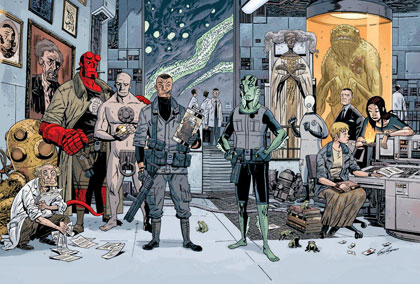
I’m not trying to be too flattertatious or anything, but B.P.R.D. is one of those books that EVERYBODY reads, from superhero fans to indie fans to whomever. What do you think the appeal of this book is, outside of its ties to Hellboy? What keeps it fresh–not only for readers, but for YOU, drawing hundreds of pages of B.P.R.D. stories over the years?

GD: Thanks! As far as the appeal goes–Mike [Mignola] has come up with a great cast of characters from Hellboy and Abe through the rest, and I was a fan of the first BPRD: Hollow Earth mini-series before I was lucky enough to get to work on it.

For me personally working on it–both Mike and John [Arcudi] keep it fresh and entertaining with all the great ideas and storylines they come up with. Whether it’s wendigo’s or frog monsters and the Black Flame–who would complain about getting to draw all that! And for me, each storyline had a different feel from the last–so Garden of Souls was different in tone and feel to what I would get to do on The Warning or Killing Ground.

Also John really makes these characters come alive, so after drawing them for a few mini-series now it’s been nice to get to draw how they’ve changed in their relationships and interaction with other characters.

DH: Is there an untapped audience out there for frog violence?

GD: Definitely–we’re your one stop read for all things frog violent!

DH: How much input do you have into the design of things–your art is so crammed with texture and detail, not to mention all the architecture and clothing and uniforms and so forth.

GD: The initial designs I do are shown to Mike, John and Scott Allie who all chime in before the finished version–but most of the final designs are worked out between me and Mike. Usually I get a series outline or script to an upcoming storyline and work up some initial designs for characters or settings and then I send those to everyone for approval–sometimes it pretty much works out with the first sketch, like on the character of The Black Flame and other times it will go back and forth with me trying different things and Mike sending sketches with ideas like we did with the Victorian cyborgs in Garden of Souls.

Most of the other smaller stuff, background architecture and settings come out just in the pencils and if something needs to be reworked I change it before inks.

DH: Okay, I know it’s obligatory, but I have to ask you about the tools that you use. You’re a nib guy, right?

GD: Yeah, I ink pretty much everything with a [Speedball] 22B nib. I really like the look of brushwork but I don’t have the steady hand for using it on finer details, so I use a #3 or #4 brush for things like hair, trees, rocks or to spot in shadows. But the rest is all quill.

DH: What do you think a nib gives you that a regular disposable pen (a Micron or brush pen, for instance) couldn’t provide?

GD: Early on before I used the nibs, I tried a technical pen but hated how it skipped alot. I’m not a slow inker (as it probably shows) so the quill lets me work more fast and expressive, it also gives me more variety of line weight. I like sketching in pens and I do convention sketches using a pen and markers which feels nice and flows easy, but I never tried it for finished work~ probably just out of habit really and more personal preference for how it feels to work with each. I’m not a tool snob, if someone wants to use tech pens, brushes or markers and it works for them~ that’s great! All that really matters is how it looks printed, and I use a lot of white out to prove that point!

DH: Do you use a lot of white-out in your art? You have such a loose style, I guess it makes sense that you’d go out of the lines sometimes.

GD: I do use it pretty freely. I don’t set out to make mistakes, but everyone does and I change my mind and try different things out on the page as I go–and if it doesn’t work or I screw up then I just white it out and try it again. For other tools of the trade type talk: I pencil using a B lead, which is soft and lets me get loose with the pencils and more expressive. Paper wise I pretty much use what Dark Horse sends me, but I guess if I have a choice I’d pick a smooth surface for inks. Black Magic ink and Pentel pen-white for the white out!

DH: Wow, I think there’s enough info in those three paragraphs to start a career in cartooning!

Okay let’s change the subject, or I’ll quiz you about nibs and brushes and ink all day. This new book of yours, The Zombies That Ate The World–that was originally published in French, right? Through Les Humanoides? I haven’t read it yet, but I’ve looked lovingly for months through my copy of one of the French albums.

GD: Yeah, the Zombies books were done for Les Humanoides Associes, originally it was a short story written by Jerry Frissen that saw print in an issue of their Metal Hurlant around 2004, but they liked the idea and how it turned out and that short turned into a serial and then it started coming out as original graphic novels with the fourth volume that saw print last year.

DH: Is it a one-time thing, or can we expect to see more after this initial series ends?

GD: That fourth volume had an ending but left it open for more stories to follow. The four French volumes are being reprinted in English now, broken up into 8 comic issues.

It was a really fun series to draw, Jerry has a great and twisted sense of humor and it was fun to draw the series in a different more cartoony style than I do on BPRD or The Marquis.

DH: Okay, don’t kill me, but I’ve never read Baker Street OR The Marquis before–which one should I read first? I need more Guy Davis!

GD: Well, I know what comps to bring you at the next Heroes Convention! The Marquis and Baker Street are pretty different, if you want devils and madness horror stories go with The Marquis. If you want a punk retelling of Sherlock Holmes type mysteries, then there’s Baker Street.

I would push The Marquis since I’m currently working on new stories and also so I can plug that The Marquis is now at Dark Horse and a huge new collection of the existing stories is slated to come out in September. It’s called The Marquis: Inferno and it’s a monster at over 300 pages, and includes a new 54 page sketchbook section along with a full color cover gallery–all the guest covers and foreign edition covers, great covers to Danse Macabre that were done by Mike Mignola, Matt Wagner, Teddy Kristensen, Kelly Jones and Charles Vess. The book is purposely done in black, white and greys–but Dave Stewart came on to recolor the Hell scenes that were just a red plate before. I’m really proud at how the books shaping up and Dark Horse is really putting a lot into this edition.

And hopefully all that will lead to more new Marquis graphic novels starting in 2010; I really want to finish off the Marquis which had 3 more series plotted out that tells the whole story. But alongside all that I’m already gearing up for the next BPRD mini-series after Black Goddess along with some other side projects at Dark Horse that I can’t really hint at.

DH: I’m putting Marquis on my “must-buy” list right now, Guy! You’ve already given me too much stuff already! I’m looking forward to seeing you again at HeroesCon. You’re going to be there all three days this year, right?

GD: All three days this time~ sorry I had to skip out early last time, but I had a great time last year and I’m really looking forward to going back.

DH: I can’t wait. One of the great crimes of HeroesCon is that we invite all these great artists and writers, but none of the staff ever get to hang out much because we’re all so busy running around!

GD: I want to see you sitting behind a table one of these year so I can dig through your portfolio!

DH: One of these years Shelton will wise up and fire me, and then I’ll finally have the time!

Hey, I’ve got one last question that Mark Burrier sent us through Facebook (if you don’t know Mark’s work, he’s an AMAZING cartoonist and illustrator). Mark wants to know: “How do you feel the market for your art has changed over the years?”

GD: Great stuff~ now Mark’s a guy who knows how to use a brush!!

That’s a tough question really, I’ve gotten a lot more interest for my work since BPRD started, and besides the connection with Hellboy which is a lot more high profile, I think BPRD has given me an opportunity to do more of the type of comics I wanted to do. I mean I’m a monster-art type of guy and I like horror and surreal stuff. So early on finding an outlet or work-for-hire type job was a lot harder because editors didn’t really know what to put me on; It seems like the market itself has grown to accept a lot more diversity and I’ve been lucky to carve out a small niche and hang on through the years.

DH: Well, if that market ever dries up, Guy, you can always come work here at Heroes. And by “work here at Heroes”, I mean doodle on stuff for us all day. In the mean time, thanks for taking time out of what must be a PACKED schedule to talk with us! Looking forward to chatting in person at HeroesCon!

GD: Thanks Dustin! See you at the show!

You can find out more about Guy Davis at his website. And of course, you can meet him this summer at HeroesCon, June 19-21. If you’ve never met him before, Guy’s a pretty shockingly friendly guy, for someone who draws demons and frogs and zombies all day.


Share

HEROES DISCUSSION GROUP PODCASTILICIOUS!

March 20, 2009 By: Dustin Harbin Category: DISCUSS, Discussion Group, EVENTS

Alright alright alright! Our chums over at The Dollar Bin, the Southeast’s fanciest comics podcast, have posted the audio of our recent Iron Man discussion group, including Matt Fraction‘s guest appearance via telephone! It sounds AMAZING, although Adam’s sound equipment is so sensitive that you can even here me at the register 30 feet away ringing people up.

For those of you who’ve never been able to experience a Discussion Group first-hand, head on over to the Dollar Bin’s site and check out the audio. And while you’re there, feel free to delight in their archive of panels from last year’s HeroesCon! And while you’re double-there, just delight in the Dollar Bin in general!

Share

REVIEW :: Loving X-Force: No Shame In My Game

March 19, 2009 By: Carlton Hargro Category: DISCUSS, Reviews

A few months ago, I wrote (in the pages of the newspaper I edit, Creative Loafing) that X-Force was one of my favorite comic books of 2008. Shortly thereafter, a blogger at Newsarama.com made fun of my pick.

I guess I’m not supposed to like a comic like X-Force. But I do. And I’m proud of it.

And, really, what’s not to like? I mean, if you like comics starring spandex-clad heroes, that is, there’s a lot to like.

The comic features an interesting mix of heroes from the X-corner of the Marvel Universe (guys and gals like Warpath, X-23, and Archangel, among others) and shows them doing what readers have wished the X-Men would do for decades: putting down the bad guys permanently. Honestly, how many times can the world’s most popular mutant heroes get impaled, poisoned and shot before they say enough is enough?

And while the heroes are interesting, X-Force’s villains are even more enthralling. Since the first issue, writers Craig Kyle and Chris Yost have thrown a legion of classic bad guys at the team — from the Demon Bear (ala the old New Mutants series) to Bastion to the Purifiers, Magus and even Cameron Hodge. I come from the school of comic reading that says a hero is only good as the villains he/she faces … which makes the X-Force crew pretty freakin’ good at what they do.

Now, those great qualities aside, is X-Force a perfect comic book? Of course not.

One of my biggest gripes with the book is the use of the character Wolfsbane. The shape-shifting hero from the old New Mutants series has always possessed a ton of potential, but in X-Force she seems to be the resident punching bag. And in the latest issue she’s been reunited with her old-time lover from Asgard. I thought I was reading a high-octane action comic, not Young Heroes in Love.

One other complaint: If you’re gonna be a black-ops team of heroes willing to murder your enemies, then don’t whine about it. I’m sure it’s difficult to create stories about people who have little regard for human/mutant life (at least when it comes to their foes), but I’d like to see everyone involved with the book just be courageous and wholeheartedly take a bloodthirsty walk on the wild side.

Still, despite these gripes, I really dig X-Force.

So there.

Carlton Hargro is Editor-In-Chief of Creative Loafing. You can read more of his writing at their website.

Share


  • heroes on facebook heroes on twitter heroes on flicker


    Click Here To Help Support The Creators That Make Comics Possible!


  • www.flickr.com